
Key Takeaways
- On October 27, 2026, Amazon published a memo from Terk Terkowitz, a VP and Distinguished Engineer, explaining its revised role guideline for software development engineers (SDEs).
- The memo calls AI input metrics such as token usage, tool adoption, code changes and reviews "deeply flawed" and says "tokenmaxxing is at odds with frugality". It keeps those metrics anyway, to be used "with care and judgement".
- Leaders are told to study the 10th and 90th percentiles of AI adoption on their teams. The bottom group gets asked why, and the top group gets asked whether delivery rose to match.
- "If your work does not benefit from current AI tooling, that is a finding, not a failing," the memo says. It asks engineers to document why and take it to their manager.
- Since April 2025, Shopify, Meta, Microsoft and Proton have each spelled out how AI use counts at work. Amazon's memo joins them, and each company draws the line between usage and results in a different place.
The Amazon tokenmaxxing memo, published on October 27, 2026, tells Amazon's software engineers that the company will judge them on outcomes for customers, not on how much AI they use. It also keeps AI usage metrics in play as a signal and says engineers who don't adopt AI are "falling behind". For engineers anywhere, it's the clearest written statement yet from a big employer of how AI use and performance now connect.
What happened
Amazon engineering leaders, "including Distinguished and Senior Principal Engineers", rewrote the role guideline that defines what an SDE at Amazon is expected to do. On October 27, Amazon published the memo that went to engineers and engineering managers alongside it, addressed "Dear SDEs and SDMs". Its central line: "Our most prolific engineers have demonstrated that neither the developer role nor their output is defined by the use of AI."
Inside the Amazon tokenmaxxing memo: what it says about AI metrics
The memo makes five commitments. Here they are in the memo's own words.
| Topic | What the memo says |
|---|---|
| What gets judged | "The outcomes that matter aren't changing, even if the inputs, tools, and techniques are changing faster than ever." |
| Usage metrics | Token usage, AI tool adoption, code changes and reviews: "We are all aware of how deeply flawed these metrics are, primarily because they are disconnected from what matters." |
| Why they stay | "These input metrics correlate well with the outputs that matter." Using them "with care and judgement" is "appropriate". |
| What leaders review | The 10th percentile of AI adoption ("teams who aren't embracing AI effectively") and the 90th ("whether they're seeing delivery increases to match"). |
| When AI doesn't help | "That is a finding, not a failing. Document why, share it with your community of peers, bring it to your manager, and work to find solutions." |
The memo names the two behaviors it wants to stop. Burning tokens to look busy is "at odds with frugality". Measuring lines of code is "at odds with invent and simplify". Both are Amazon Leadership Principles, so the warning is written in the company's own core vocabulary.
The part that didn't change
Read the memo as a retreat from AI and you'll miss half of it. It says "AI will be at the center of software engineering practice" and tells engineers who haven't started to "learn and apply AI into your daily work as soon as possible". It says "teams and individuals who are not adopting AI or increasing output metrics are falling behind". It also sets a bar for managers: they should have used the tools "on your production work" and be able to "describe a task where they helped and a task where they did not".
Amazon hasn't published the role guideline itself, only the memo about it. The memo doesn't say how much weight AI metrics carry in a review, or whether they're tracked per person or per team.
Why "tokenmaxxing" is in an official document
Amazon has dealt with this before. In May 2026, it shut down KiroRank, an informal leaderboard built by a group of employees that tracked AI token use, Business Insider reported. Senior vice president Dave Treadwell told staff: "Please don't use AI just for the sake of using AI." The new memo turns that message into written guidance tied to the job definition.
The numbers behind it
The memo's claim that input metrics are "disconnected from what matters" has outside support. A Harvard working paper by Fiona Chen and James Stratton used Jellyfish engineering data from more than 700 firms. It found that after firms adopted AI coding agents, lines of code rose 30%, commits rose 20% and pull requests rose 23%. The resolution rate of Jira issues and epics, the authors' proxy for finished work, showed no statistically significant change. The time from pull request to merge rose 49%, Ars Technica reported.
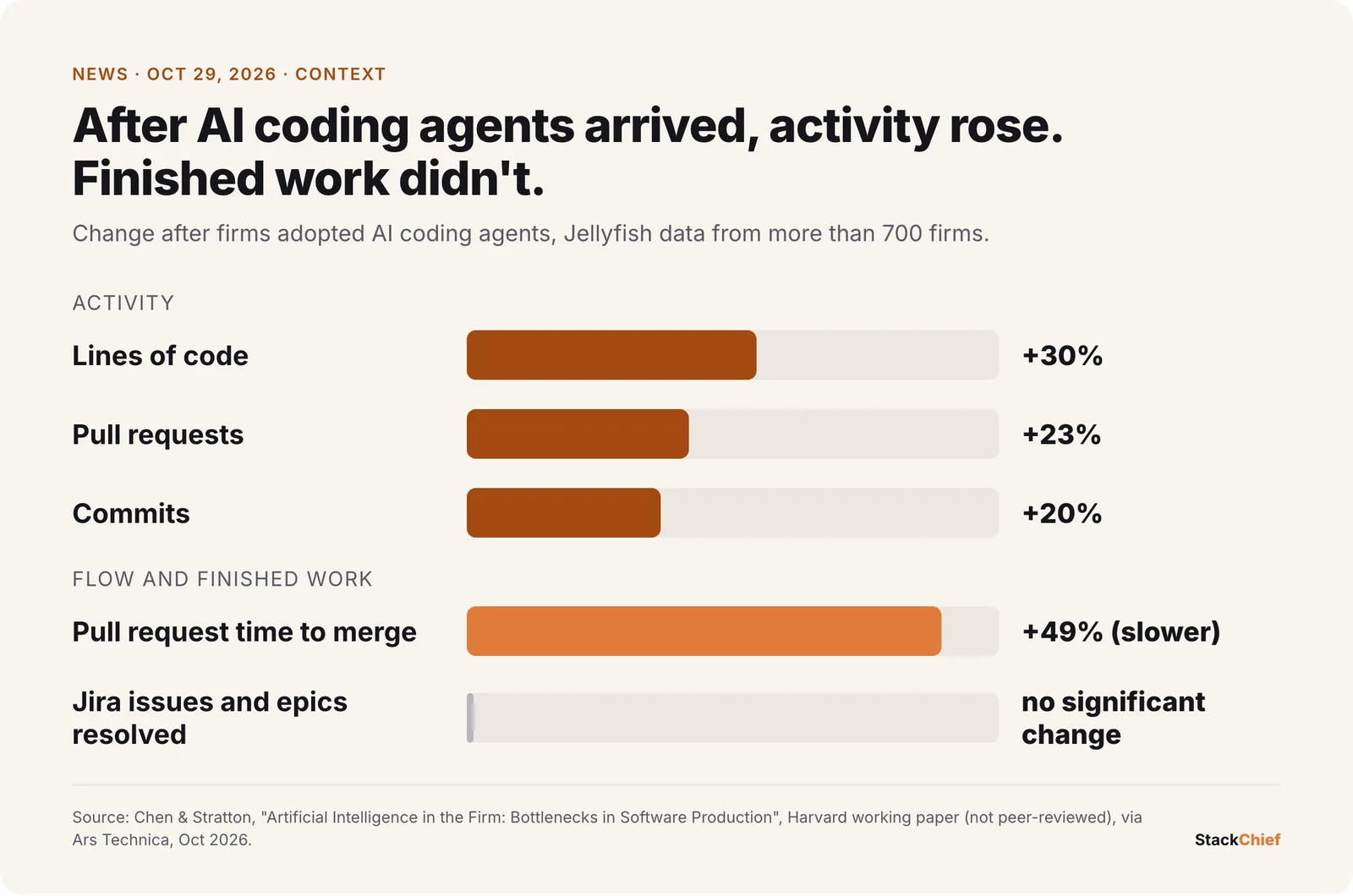
That's exactly the gap between a "throughput metric" and an outcome. A team can raise every activity number on that chart without shipping more. The data has limits, though. It's a working paper, not yet peer-reviewed, and it uses one vendor's customers. It doesn't include Amazon, and Amazon says its own frontier teams show "increasing productivity and delivery". Neither source proves the other wrong. They measure different things.
The day after
On October 28, Amazon cut about 250 roles in its devices unit, mostly in software development, The Federal and Business Today reported. Amazon confirmed the cuts but not the number. It said: "We've made the difficult decision to eliminate a small number of roles." Amazon hasn't connected the cuts to the memo, and no report shows a link.
How other employers count AI use
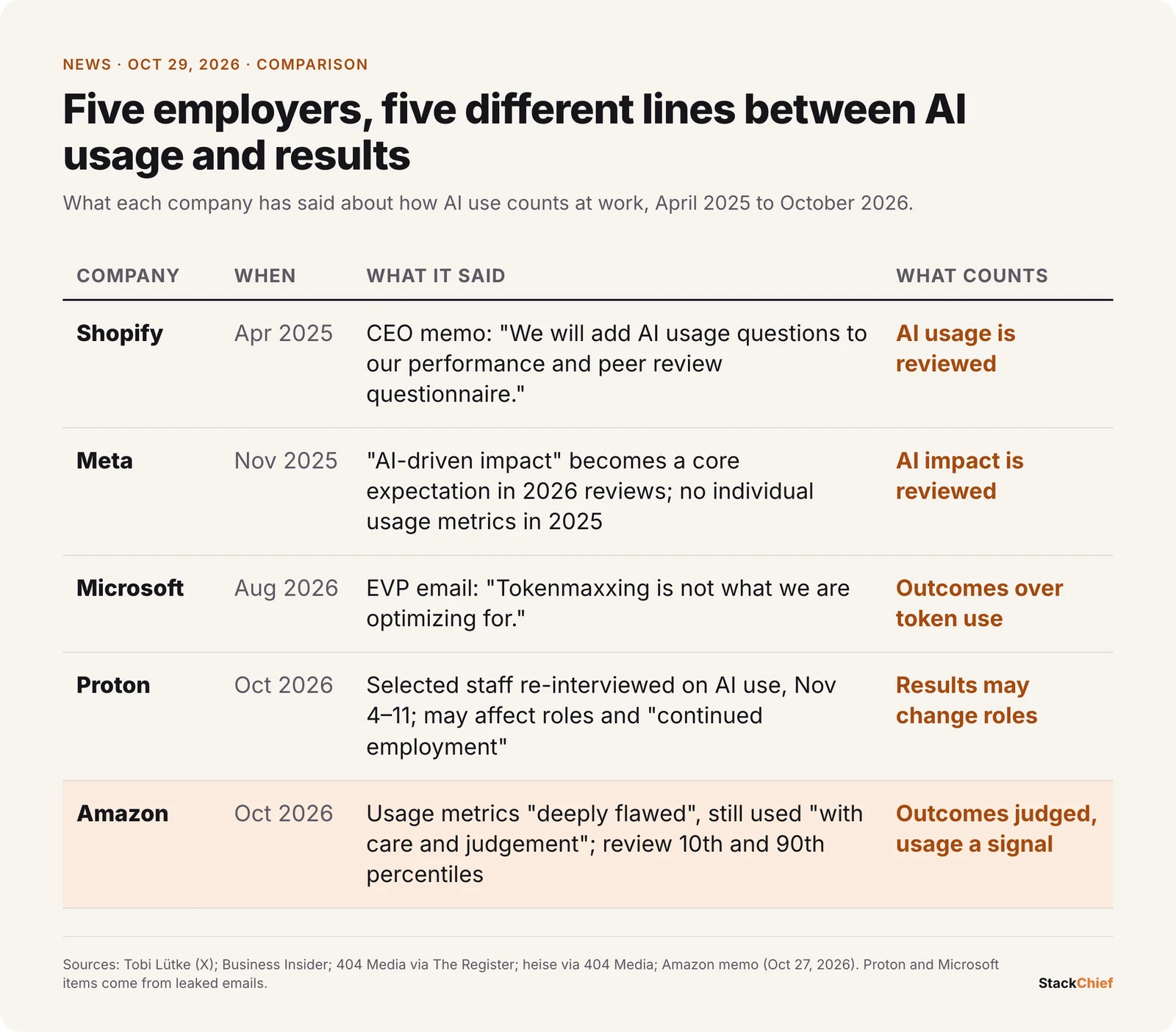
Amazon's memo is the latest in a line of company statements, and they don't agree. The table in the hero image shows the spread. Here are the specifics.
- Shopify, April 2025: CEO Tobi Lütke posted his memo, "Reflexive AI usage is now a baseline expectation at Shopify." It says: "We will add AI usage questions to our performance and peer review questionnaire."
- Meta, November 2025: head of people Janelle Gale told staff that "AI-driven impact" becomes a core expectation in 2026 reviews. For 2025, individual usage metrics stayed out of reviews, Business Insider reported.
- Microsoft, August 2026: executive vice president Jay Parikh wrote in an email that "Tokenmaxxing is not what we are optimizing for," according to 404 Media and The Register.
- Proton, October 2026: a leaked email says selected staff will be re-interviewed on their AI use from November 4 to 11, and the results may lead "to changes in roles, responsibilities, and continued employment", heise reported, citing 404 Media. Proton later said it isn't doing layoffs.
None of the five is backing off AI. What's shifting is the unit of proof, from usage counts to examples of results.
What this means for you
If you're an engineer at Amazon
- Write up results, not activity. The memo says outcomes are what's judged. For each AI-assisted change, record what shipped and what it did for a customer.
- Document where AI didn't help. The memo asks for exactly that, and says it shows "the judgement we are asking for". A one-page note to your manager counts.
- Know which percentile your team is in. Both ends get attention. A team at the 90th percentile with flat delivery will get questions too.
If you work somewhere else
- Expect usage data to come up in reviews. Shopify, Meta and Proton have tied AI use to reviews or role decisions, according to the companies or to reporting. Ask your manager which metrics exist and how they're used.
- Don't optimize the counter. Shopify, Meta, Microsoft and Amazon all say results matter more than volume.
If you're job hunting
- Prepare two AI stories. One where AI sped up real delivery, with a number. One where it didn't help, and what you did instead. That second story matches the judgement the Amazon memo asks engineers to show, and behavioral interviews reward it.
How this connects
Our analysis of whether AI will replace software engineers argued that the bottleneck moved from writing code to reviewing and shipping it. Amazon's memo makes the same point inside one of the largest engineering organizations. The software engineer job market 2026 data shows the same tilt, with postings growth strongest in senior and AI-focused roles. For the other big change this week, see the Microsoft voluntary buyout.
What's new is the interview angle. If employers grade engineers on judgement about AI, interviewers will probe it. Our guide to coding interviews in the age of AI covers the rounds, and behavioral interview questions for software engineers covers the story format. The Mastering the Tech Interview book walks through building those stories for every stage of the loop.
FAQ
What is tokenmaxxing?
Tokenmaxxing means using AI tools more than a task needs, burning tokens, to raise usage numbers. Amazon's October 27, 2026 memo says "tokenmaxxing is at odds with frugality", and Microsoft's Jay Parikh wrote that it's "not what we are optimizing for".
Does Amazon still track engineers' AI usage?
Yes. The memo calls token usage, tool adoption and code-volume metrics "deeply flawed" but says they "correlate well with the outputs that matter". It recommends using them "with care and judgement", and asks leaders to look at the 10th and 90th percentiles of adoption.
Who wrote the Amazon memo?
Terk Terkowitz, VP and Distinguished Engineer for Worldwide Amazon Stores. He wrote that it came from Amazon engineering leadership, including Distinguished and Senior Principal Engineers. Amazon published it on aboutamazon.com on October 27, 2026.
What should I do if AI doesn't help my work?
At Amazon, the memo says it's "a finding, not a failing": document why, share it with peers, bring it to your manager and work on solutions. Elsewhere, ask how your company measures AI use before you assume it counts against you.
Further Reading
- Amazon: An update from Amazon engineering leadership on the role of the developer in the age of AI — the full memo (October 27, 2026).
- Ars Technica: AI coding agents generate more code, but not more software — the Harvard working paper's results.
- Business Insider: Amazon shuts down its KiroRank token leaderboard (May 29, 2026).
- The Register: Microsoft tells engineers to curb their token-burning enthusiasm (August 5, 2026).
