
Key Takeaways
- The Bureau of Labor Statistics reported on November 6, 2026 that US payrolls rose by 165,000 in October and that the unemployment rate was little changed at 4.1%.
- Employment in computer systems design and related services, the BLS industry closest to "software services company", was 2,354,100 in October 2026. That is 25,600 fewer than in October 2025, even though October itself added 3,200.
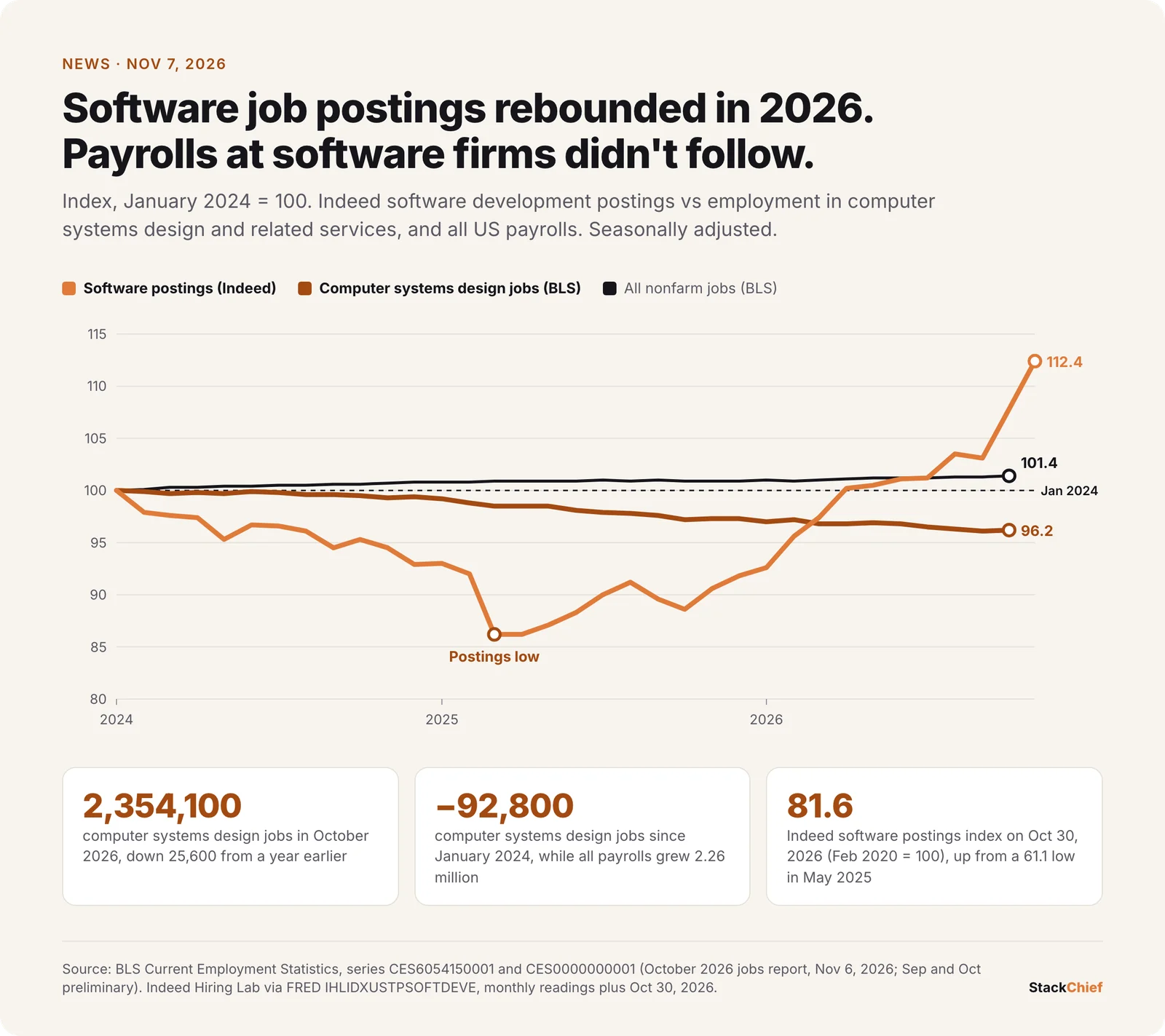
- Since January 2024, that industry has lost 92,800 jobs (3.8%) while total US payrolls grew by 2.26 million (1.4%), by our calculation from BLS data.
- Hiring signals point the other way. CompTIA's November 6 analysis put October IT unemployment at 2.8% and new IT job postings 22.2% above October 2025, and Indeed's software postings index reached 81.6 on October 30, 2026.
- Openings are rising faster than headcount at software firms. Consulting and professional services added jobs over the year, while publishing, data processing and the information sector shrank.
The October 2026 jobs report, released on November 6, gave software engineers two stories at once. Payrolls grew by 165,000 and tech job postings kept climbing, but employment at the firms that build and run software for others is still lower than it was a year ago. This post sets the report's software-relevant industry lines against the postings data, then covers what that gap means if you're job hunting.
What happened
At 8:30 a.m. Eastern on Friday, November 6, 2026, the BLS published The Employment Situation for October 2026. In the agency's words, "Total nonfarm payroll employment rose by 165,000 in October," and the unemployment rate "changed little at 4.1 percent." The BLS also revised August up to +186,000 and September up to +60,000, a combined 84,000 more jobs than first reported.
Professional and business services led the gains with +70,000, which the BLS called "well above the average monthly gain of 15,000 over the prior 12 months." The information sector, home to software publishers and data processing, was flat at −1,000.
The details that matter to engineers
The BLS doesn't publish a monthly "software engineer" job count in this report. What it publishes is employment by industry. Four industry lines in Table B-1 cover the software-heavy parts of the economy. A fifth, management and technical consulting, is a growing industry next to them. The table below sets each against its level a year earlier, next to the two hiring-side measures released the same week.
| Measure (October 2026) | Source | A year earlier | October 2026 | Change |
|---|---|---|---|---|
| All nonfarm payrolls | BLS | 158,408,000 | 159,293,000 | +885,000 (+0.6%) |
| Computer systems design and related services | BLS | 2,379,700 | 2,354,100 | −25,600 (−1.1%) |
| Publishing industries (includes software publishers) | BLS | 903,500 | 880,000 | −23,500 (−2.6%) |
| Computing infrastructure, data processing and web hosting | BLS | 480,700 | 454,800 | −25,900 (−5.4%) |
| Information sector (all) | BLS | 2,853,000 | 2,734,000 | −119,000 (−4.2%) |
| Management, scientific and technical consulting | BLS | 1,860,000 | 1,905,700 | +45,700 (+2.5%) |
| New IT job postings in the month | CompTIA (Lightcast) | not given | 290,892 | +22.2% year over year |
| IT occupation unemployment rate | CompTIA (BLS) | 3.3% (September 2026) | 2.8% | −0.5 points in a month |
BLS figures are seasonally adjusted. The year-over-year changes are our calculation from Table B-1 and the BLS series. CompTIA didn't publish an October 2025 posting count in this release, only the growth rate.
A good month inside a weak year
October was the first month of growth for computer systems design employment since May. The industry added 3,200 jobs after falling in eight of the previous twelve months, and September's 2,350,900 was its lowest level in the 34 months of data since January 2024. One month of growth doesn't change the trend: the industry is 26,500 jobs below where it ended 2025.
The hiring side of the same week
CompTIA's Tech Jobs Report, published the same morning, counts occupations rather than industries. It found that IT occupations across the economy "increased by approximately 26,000 jobs" in October and that the IT unemployment rate "declined to 2.8%." Software developer and engineer roles led postings with 51,944 new listings, up 6.3% from September. CompTIA notes that monthly occupation-level BLS data is volatile. A half-point drop in one month is a reading to confirm, not a trend.
The numbers behind the October 2026 jobs report
The chart above shows the gap. Indexed to January 2024, Indeed's software development postings bottomed out in 2025 and were at 112.4 by October 30, 2026. In Indeed's own terms, that's an index of 81.6 against February 2020 = 100, up from a low of 61.1 in May 2025. Over the same stretch, total US payrolls rose to 101.4 and computer systems design employment slid to 96.2.
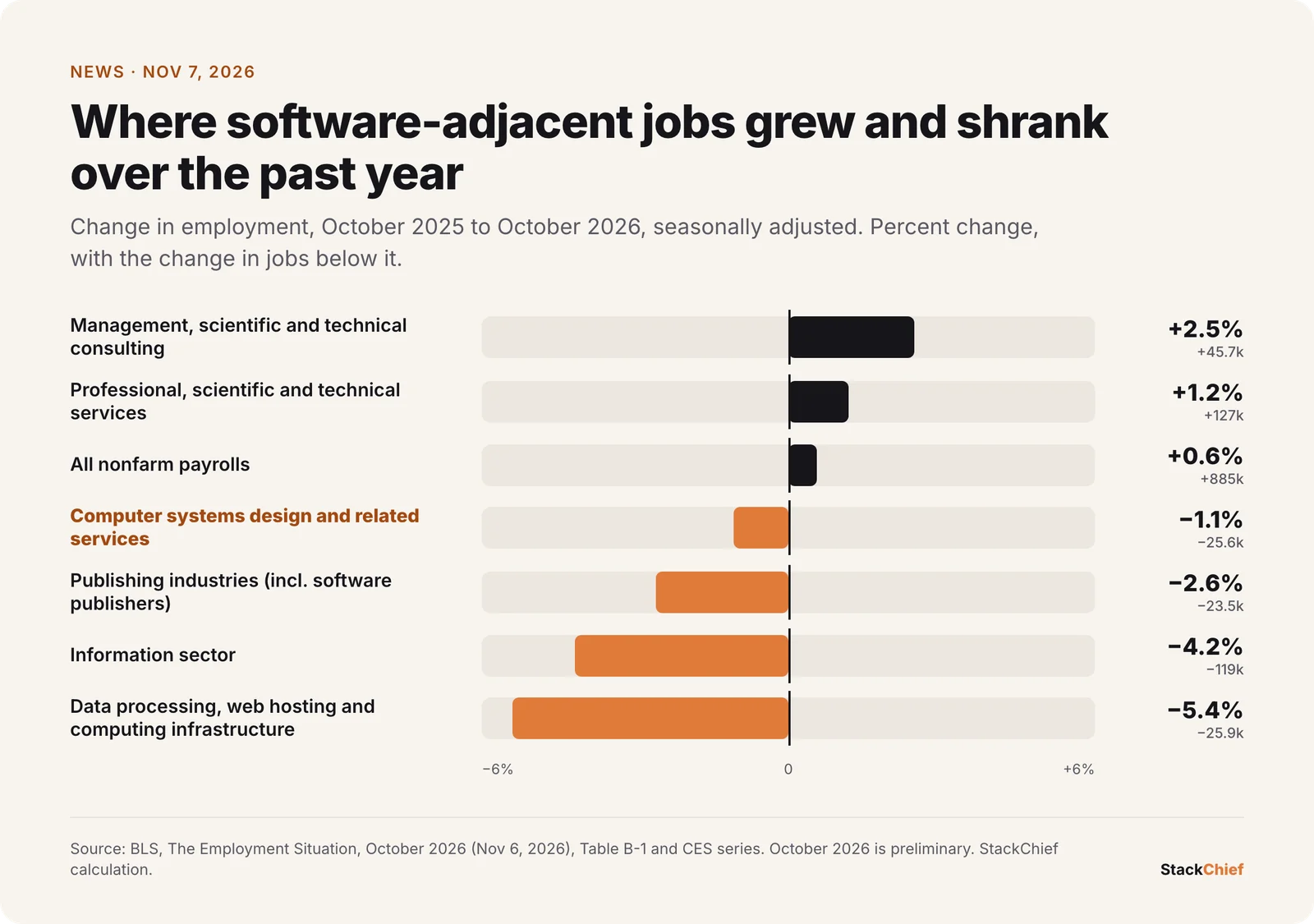
Professional, scientific and technical services, the parent industry of computer systems design, grew 1.2% over the year. All of that growth came from its other parts, led by management and technical consulting at +2.5%. Inside the information sector, data processing and hosting fell 5.4% and publishing fell 2.6%.
What the data can't tell you
Industry counts aren't occupation counts. A software engineer at a bank or a hospital is counted in finance or health care, not in computer systems design. Postings aren't hires either: a rising postings index can mean more openings, or openings that stay up longer. The data shows the two moving apart. It doesn't say why, and neither the BLS nor CompTIA attributes the gap to AI or anything else. The last two months are preliminary and will be revised on December 4.
What this means for you
If you're job hunting
- Budget for a long search. More postings haven't turned into more net jobs at software firms, so plan for a search that takes longer than the postings count suggests.
- Widen the employer list. Consulting added 45,700 jobs over the year while data processing and hosting lost 25,900. Engineering roles inside consulting firms and non-tech employers belong on your target list.
- Read the seniority mix. Indeed Hiring Lab found that in Q1 2026, 69.3% of software development postings were senior and 4.5% were entry-level. If you're early in your career, rising postings help you least.
If you're employed
- Don't read a 2.8% unemployment rate as safety. It's an occupation-wide rate for IT workers. The industries most exposed to software budgets are the ones still shrinking.
- Watch your own employer's industry line. Check its BLS series once a month rather than reacting to the headline payroll number.
How this connects
Our software engineer job market 2026 hub tracks these series every month. The October report adds a clearer view of the split between openings and headcount. That split also fits the corporate news of the past two weeks, from the Microsoft voluntary buyout offer to Canva's restructure. For the longer question of whether AI is behind the shrinking headcount, see what the 2026 data says about AI replacing software engineers. Pay data is in our software engineer salary 2026 guide.
When postings grow faster than headcount, the interview decides who gets the jobs that do open. If yours is about to start, Mastering the Tech Interview covers the coding, system design and behavioral rounds you'll face.
FAQ
How many jobs were added in the October 2026 jobs report?
The BLS reported on November 6, 2026 that total nonfarm payrolls rose by 165,000 in October. The unemployment rate was little changed at 4.1%, and August and September were revised up by a combined 84,000.
Are software jobs growing in 2026?
Postings are. Industry payrolls aren't. Employment in computer systems design and related services was 2,354,100 in October 2026, down 25,600 from a year earlier. Indeed's software development postings index rose to 81.6 on October 30, 2026, from a low of 61.1 in May 2025.
What was the tech unemployment rate in October 2026?
CompTIA's analysis of BLS data put the unemployment rate for IT occupations at 2.8% in October 2026, down from 3.3% in September and below the national rate of 4.1%. CompTIA cautions that monthly occupation data is volatile.
When is the next jobs report?
The BLS has scheduled the November 2026 Employment Situation for Friday, December 4, 2026, at 8:30 a.m. Eastern. It will also revise the September and October figures used here.
Further Reading
- BLS, The Employment Situation — October 2026: the release text, Summary Table B and Table B-1 industry detail.
- BLS series CES6054150001: monthly employment in computer systems design and related services.
- CompTIA, "Tech employment gains momentum in October": IT occupation employment, unemployment and Lightcast postings.
- FRED, Software Development Job Postings on Indeed: the daily postings index, February 2020 = 100.
- Indeed Hiring Lab, "The Labor Market Is Tilting Toward Seniority": the senior and entry-level shares of software postings.
