
Key Takeaways
- A study submitted to arXiv on November 20, 2026 by researchers at Utah State University and Aalto University asked 48 programmers to rate 26 activities twice: once for programming with AI and once without it.
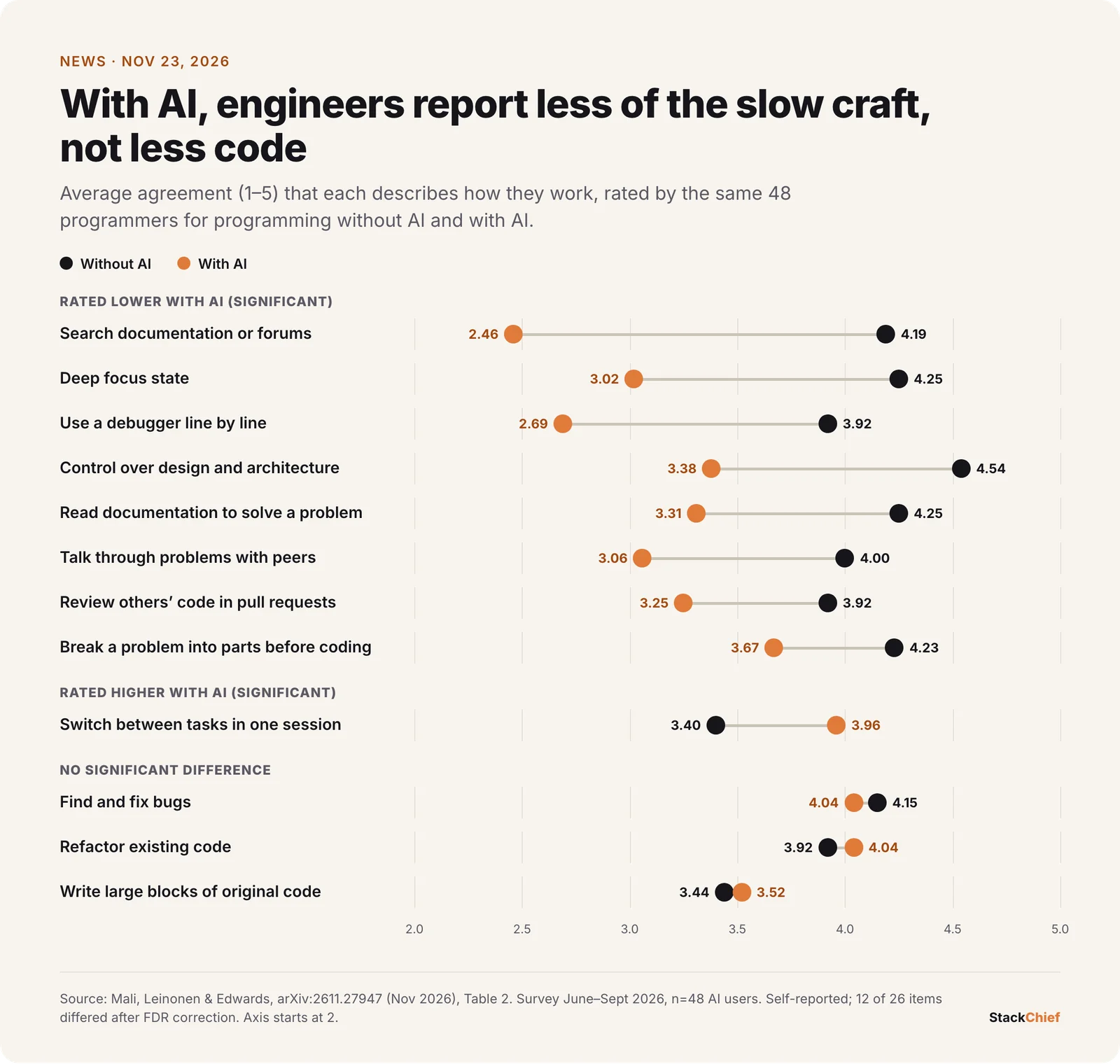
- In the survey, fielded June to September 2026, 12 of the 26 activities differed significantly, and 11 of those were rated lower with AI. The biggest drops were in searching documentation or forums (4.19 to 2.46 on a 5-point scale), deep focus (4.25 to 3.02) and stepping through code with a debugger (3.92 to 2.69).
- Producing code barely changed in the same 2026 survey: writing large blocks of code, refactoring and finding and fixing bugs showed no significant difference, and bug fixing tested as statistically equivalent.
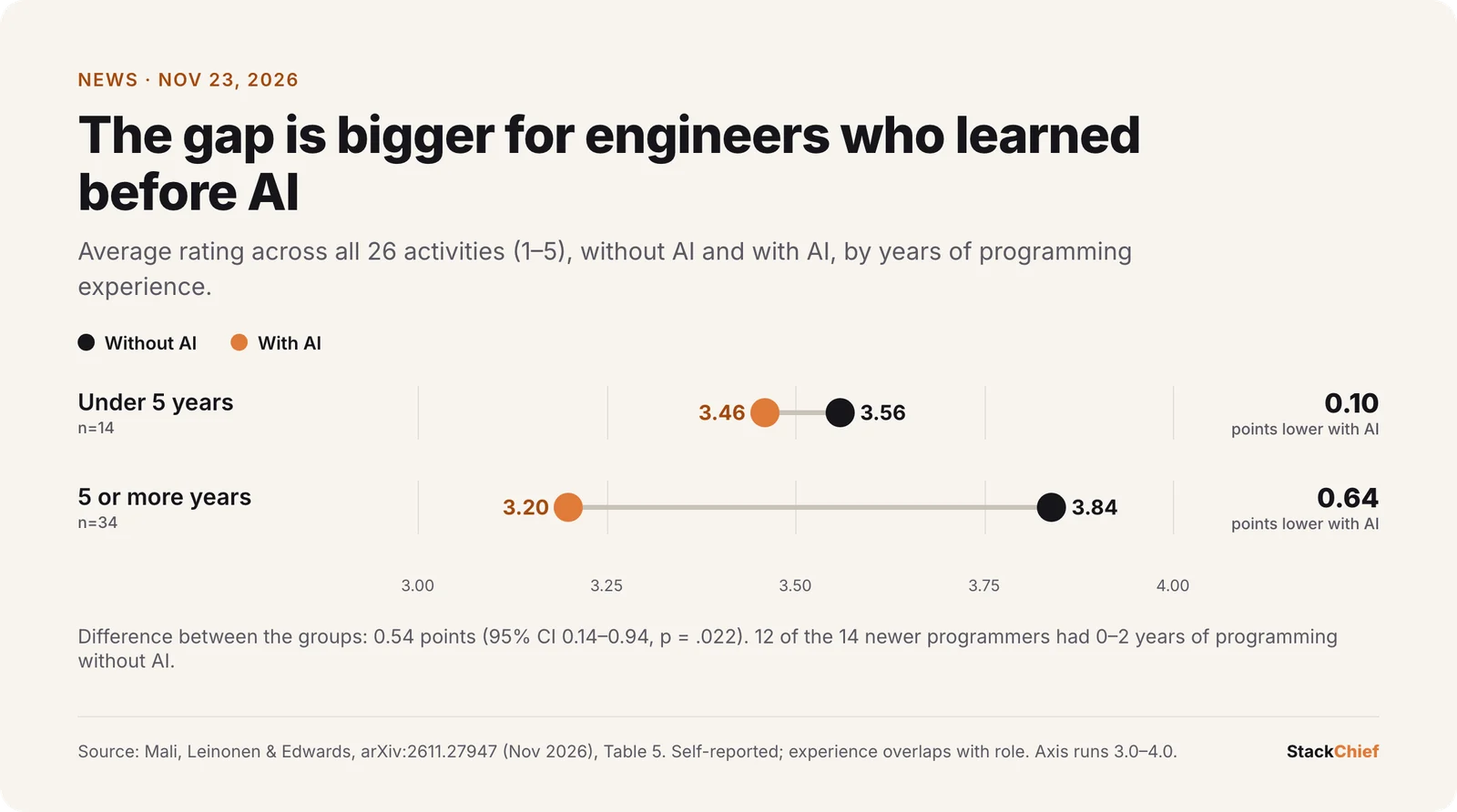
- In the November 2026 paper, programmers with 5 or more years of experience reported a much larger gap than those with under 5 years (an average of −0.64 vs −0.10 points per item), the pattern the authors call an "experience gradient."
- The survey used a convenience sample recruited online and at one US university. It measures what people say they do, not what they do, and it isn't peer reviewed yet.
A new programming with AI vs without AI study, posted to arXiv on November 20, 2026, finds that engineers report doing less of the slow parts of the craft when AI is in the loop: less reading documentation, less debugging step by step, less talking problems through with colleagues, less deep focus. The code they produce, by their own account, looks about the same. We put the paper's numbers next to Anthropic's controlled experiment on AI and coding skills, then map each drop to the interview round that still tests it.
What happened
Rubash Mali and John Edwards of Utah State University and Juho Leinonen of Aalto University posted "Perceived Differences in Activity and Experience Between Developing Software With and Without AI" to arXiv on November 20, 2026. They surveyed programmers between June and September 2026. Each person rated 26 programming activities and experiences on a 5-point agreement scale twice, once for working with AI and once for working without it. They kept 48 complete responses from people who use AI: 33 software engineers, 9 students and 6 researchers or educators. The question applies widely: in the Stack Overflow 2026 Developer Survey, 73% of respondents who use coding assistants or agents use them every day.
The details that matter to engineers
What respondents do less with AI
Twelve of the 26 items differed after the authors corrected for multiple comparisons, and eight held up under a stricter correction. Eleven of the twelve were lower with AI. The authors write: "We call these the different craft results."
- Finding answers yourself. Searching documentation or forums such as Stack Overflow fell from 4.19 to 2.46, the largest drop in the survey. Reading documentation to solve a problem fell from 4.25 to 3.31.
- Debugging by hand. Using a debugger to step through code line by line fell from 3.92 to 2.69.
- Thinking before typing. Breaking a large problem into smaller parts before writing code fell from 4.23 to 3.67.
- Working with people. Talking through technical problems with peers fell from 4.00 to 3.06, and reviewing other developers' pull requests fell from 3.92 to 3.25.
- Owning the design. Feeling in control of code design and architecture fell from 4.54 to 3.38, and deep focus "where time passes unnoticed" fell from 4.25 to 3.02.
One item went up: switching between programming tasks in a session rose from 3.40 to 3.96. Respondents also said they lose track of what a piece of code is supposed to do more often with AI. The paper reverse-scores that item, so its score fell from 3.15 without AI to 2.27 with it.
What didn't change
The core production work showed no significant difference: writing large blocks of original code (3.44 without AI, 3.52 with), refactoring (3.92 vs 4.04), writing unit tests by hand (3.40 vs 3.48) and finding and fixing bugs (4.15 vs 4.04). For bug fixing, the authors ran an equivalence test and found the two conditions equivalent within half a point. So engineers still say they fix bugs as much as before. What they report doing less is the manual way of getting there, such as stepping through code with a debugger.
The experience gradient
The gap depended on experience. Respondents with under 5 years of programming rated the two conditions almost the same on average (3.56 without AI, 3.46 with). Respondents with 5 or more years reported a larger drop (3.84 without AI, 3.20 with). The difference between the groups, 0.54 points, was statistically significant (p = .022), and the more experienced group was more negative on 23 of the 26 items. Twelve of the 14 newer programmers had two years or less of programming without AI, so for them the "without AI" baseline is short.
The programming with AI vs without AI study, checked against an experiment
A survey of 48 people is a small, self-selected sample, so it helps to set it against a controlled test. In January 2026, Anthropic ran a randomized experiment with 52 mostly junior engineers learning an unfamiliar Python library. Two different methods point the same way on debugging:
| Mali, Leinonen & Edwards (Nov 2026) | Anthropic skill-formation study (Jan 2026) | |
|---|---|---|
| Design | Survey: each person rates 26 activities with and without AI | Randomized experiment: AI group vs hand-coding group |
| Who | 48 AI users: engineers, students, researchers | 52 engineers, mostly junior, new to the Trio library |
| What's measured | How often people say they do each activity | Quiz score after the task, and time taken |
| Speed or output | Writing, refactoring and bug fixing: no significant change | AI group about two minutes faster, not significant |
| Debugging | Step-through debugger use: 3.92 to 2.69 | Largest quiz gap was on debugging questions |
| Learning | Documentation search: 4.19 to 2.46 | Quiz average 50% with AI vs 67% by hand |
| Who's affected most | Engineers with 5+ years report the bigger gap | Juniors tested; those who asked AI for explanations scored highest |
Neither study measures long-term skill loss, and the populations differ. The survey records what people say they do, not what they can do. The experiment measured what people learned in one session. Both point the same way: with AI, people do less of the work that builds debugging skill and understanding of the code.
Limits of the data
The authors list the limits themselves. Every measure is a self-report, partly from memory, on single survey items that haven't been validated. "Programming with AI" wasn't defined, so one respondent may mean autocomplete and another a coding agent. Experience overlaps with role: 8 of the 9 students are in the under-5-years group. The five-year cutoff was chosen after the data came in, and responses were anonymous. Treat the direction as the finding, and the exact numbers as rough.
What this means for you
Many live coding rounds still run without AI. Anthropic's candidate guidance for live interviews, for example, says: "This is all you–no AI assistance unless we indicate otherwise." Rounds like that score the activities this survey says engineers do less of. Here's how the study's significant items map to what interviewers look for:
| Activity (without AI → with AI) | Where interviews test it | A weekly drill |
|---|---|---|
| Break a problem into parts before coding (4.23 → 3.67) | The first five minutes of a coding round: clarifying questions and a plan before code | Write the plan as comments before any code, AI off |
| Step through code with a debugger (3.92 → 2.69) | Debugging rounds and "your code fails this input, why?" follow-ups | Fix one real bug a week by tracing it yourself before asking a model |
| Talk through problems with peers (4.00 → 3.06) | Thinking out loud while you solve the problem | Explain one change out loud, to a teammate or a recording |
| Control over design and architecture (4.54 → 3.38) | System design: you own every trade-off you name | Sketch the design and its trade-offs before prompting for code |
| Review others' pull requests (3.92 → 3.25) | Code review and code-reading rounds, including AI-enabled ones | Review one teammate's PR line by line each week |
| Read or search documentation (4.25 → 3.31; 4.19 → 2.46) | Using an unfamiliar API under time pressure | Learn one library from its docs, not from generated examples |
If you're job hunting
Your daily work with AI may not be giving you live-round practice. Schedule AI-off sessions on the four skills at the top of the table. Anthropic's experiment suggests how to use AI the rest of the time: participants who asked for explanations or conceptual answers scored well, and those who delegated the work to AI or kept pasting errors back into it scored lower.
If you're a senior engineer
The biggest gap in this survey belongs to you. Engineers with five or more years reported the larger shift, and they also have the longest pre-AI baseline to compare against. If you interview candidates or mentor juniors, keep your own debugging and design skills sharp, since you're the one judging theirs.
If you hire or train engineers
The authors call for updated recruitment strategies and training curricula. One practical step is to make sure juniors still trace bugs by hand and review code, because the survey suggests daily AI work no longer supplies that practice.
How this connects
This adds the engineer's own view to a run of measured studies. The Harvard AI coding agents study found firms producing much more code without a matching rise in finished work. This survey suggests what changed day to day: less solo digging, more task switching. For what it means for jobs overall, see Will AI Replace Software Engineers? What the 2026 Data Actually Says.
Interview loops are moving in two directions. Some companies now allow AI in a round, and Coding Interviews in the Age of AI tracks which ones. At Anthropic, one hiring manager dropped coding interviews entirely. Either way, a coding round asks you to break a problem down, debug and explain your reasoning, the activities this survey finds engineers do less at work. Mastering the Tech Interview is built around those rounds, with drills you can run without AI.
FAQ
Does using AI make programmers worse at debugging?
No study has shown that yet. In this November 2026 survey, programmers said they step through code with a debugger much less often with AI (2.69 vs 3.92 on a 5-point scale), but they said they find and fix bugs about as much as before. In Anthropic's January 2026 experiment, the AI group's largest quiz gap was on debugging questions. Neither study measured skill over time.
What did the programming with AI vs without AI study find?
Of 26 activities, 12 differed significantly, and 11 were rated lower with AI. The largest drops were in searching documentation or forums, deep focus, debugger use and feeling in control of design. Writing, refactoring and fixing code showed no significant difference.
Are experienced developers more affected by AI than juniors?
In this sample, yes. Respondents with 5 or more years of programming reported an average gap of 0.64 points per activity, compared with 0.10 for those with under 5 years. Most of the newer group had little experience programming without AI, so they had less to compare against.
How reliable is the study?
Treat it as an early signal. It's a preprint based on 48 self-selected respondents who answered from memory, and "programming with AI" wasn't defined. The direction matches Anthropic's randomized experiment, but neither study tracks skills over time.
Further Reading
- Mali, Leinonen & Edwards, "Perceived Differences in Activity and Experience Between Developing Software With and Without AI": the paper, methods and all 26 items (arXiv, November 2026).
- Anthropic, "How AI assistance impacts the formation of coding skills": the randomized experiment with 52 engineers (January 2026).
- Anthropic, guidance on candidates' AI usage: an example of a no-AI live interview policy.
- Stack Overflow 2026 Developer Survey, AI section: how many developers use AI coding tools daily.
